Wireless Ultrasound Probes 2026: The Complete Buyer's Guide
The wireless ultrasound probe market has matured rapidly, and 2026 brings a new generation of handheld devices that rival cart-based systems in image quality wh
This article may contain affiliate links. If you make a purchase through these links, we may earn a small commission at no extra cost to you.
Wireless Ultrasound Probes 2026: The Complete Buyer's Guide
The wireless ultrasound probe market has matured rapidly, and 2026 brings a new generation of handheld devices that rival cart-based systems in image quality while fitting in your lab coat pocket. Whether you're a primary care physician adding point-of-care ultrasound (POCUS) to your practice, an emergency medicine specialist, or a veterinary professional, choosing the right wireless probe is a decision that affects your diagnostic confidence daily.
This guide breaks down what matters most when selecting a wireless ultrasound probe this year — from image quality and battery life to connectivity and total cost of ownership.
Why Wireless Ultrasound Probes Have Become Essential in 2026
The shift toward wireless probes is no longer a trend — it's the standard for point-of-care imaging. Several factors are driving adoption in 2026:
- AI-powered diagnostics are now built into most companion apps, offering automated measurements, organ identification, and pathology flagging in real time.
- Dual-element and triple-element transducers pack linear, convex, and phased array capabilities into a single probe, eliminating the need to carry multiple devices.
- 5G and Wi-Fi 6E connectivity have solved the latency problems that plagued earlier generations. Image streaming to tablets and smartphones is now virtually lag-free.
- Regulatory clearance has expanded globally, with more FDA-cleared and CE-marked handheld devices available than ever before.
Clinics that previously relied on shared cart-based machines are now equipping individual providers with their own wireless probes. The per-unit cost has dropped enough to make this practical even for smaller practices.
Top Wireless Ultrasound Probes Compared
The following table compares the leading wireless ultrasound probes available in 2026 across key specifications:
| Feature | Butterfly iQ3+ | Clarius HD3 C7 | GE Vscan Air CL | Philips Lumify C5-2 | EagleView Pro |
|---|---|---|---|---|---|
| Transducer Type | Single crystal, whole-body | Convex (dedicated) | Dual probe (linear + convex) | Convex | Dual-element |
| Image Modes | B-mode, M-mode, Color Doppler, PW | B-mode, M-mode, Color/Power Doppler | B-mode, M-mode, Color Doppler | B-mode, M-mode, Color Doppler | B-mode, M-mode, Color Doppler |
| AI Features | Auto-calculations, guided protocols | Smart annotations | Auto-optimization | No built-in AI | Basic AI assist |
| Battery Life | ~2.5 hours | ~1.5 hours | ~1 hour per probe | N/A (phone-powered) | ~3 hours |
| Connectivity | Wi-Fi 6E | Wi-Fi 6 | Wi-Fi 6 | USB-C (wired) | Wi-Fi 6E + Bluetooth |
| Weight | 320g | 390g | 210g (per probe) | 100g (probe only) | 280g |
| Approx. Price | $3,500–$4,200 | $5,500–$7,900 | $4,000–$5,500 | $2,000–$3,500 | $2,800–$3,800 |
| Subscription | Required ($420–$600/yr) | Optional cloud plan | None | None | Optional ($200/yr) |
Prices vary based on configuration, subscription tier, and whether you purchase new or refurbished. You can often find previous-generation models at significant discounts — browse current ultrasound probe listings on eBay or check ultrasound equipment deals on Amazon for competitive pricing.
Key Features to Evaluate Before You Buy
Not all wireless probes are created equal. Here are the specifications that should drive your decision:
Image Quality and Depth
Look for probes that offer at least 30 cm scanning depth for abdominal and obstetric applications. In 2026, the best devices deliver 90+ frames per second with crystal-clear B-mode imaging. If you primarily do superficial scanning (MSK, vascular access, thyroid), a high-frequency linear probe with 4–6 cm depth may be sufficient and will offer superior resolution at shallow depths.
Transducer Versatility
A dual- or triple-element probe saves money and eliminates the need to carry multiple devices. However, dedicated single-transducer probes (like the Clarius HD3 series) often deliver marginally better image quality for their specific use case. Consider how many scan types you perform regularly before choosing versatility over specialization.
Battery and Durability
Battery life ranges from roughly one hour (GE Vscan Air) to three hours (EagleView Pro). If you perform more than 8–10 scans per shift, either choose a long-battery model or budget for a second probe. Also check the IP rating — an IP67 or higher rating means the probe can handle full immersion cleaning, which is critical for infection control.
Software Ecosystem
The companion app matters as much as the hardware. Evaluate:
- DICOM export for integration with your EMR/PACS
- Cloud storage and sharing for telemedicine consultations
- AI-assisted measurements that reduce inter-operator variability
- Offline functionality for rural or field medicine use
Total Cost of Ownership
The sticker price is only part of the equation. Factor in:
- Annual subscriptions (Butterfly requires one; others make it optional)
- Extended warranties (typically $300–$800/year)
- Replacement probes (transducer elements degrade after 3–5 years of heavy use)
- Training costs (most vendors offer free onboarding, but advanced courses may cost $500–$1,500)
A probe that costs $3,500 upfront with a $500/year subscription will run you $6,000 over five years — comparable to a $5,500 device with no recurring fees.
Where to Find the Best Deals on Wireless Probes
New wireless ultrasound probes typically range from $2,000 to $8,000 depending on the brand and configuration. Here are strategies to reduce your costs:
Certified refurbished units from manufacturer programs offer 15–30% savings with warranty coverage. These undergo factory reconditioning and testing before resale.
Previous-generation models drop in price when new versions launch. A Butterfly iQ3 (non-plus) or Clarius HD C7 from 2024 still delivers excellent imaging at a fraction of the current-model cost. Search eBay for discounted wireless ultrasound probes from medical equipment sellers with verified ratings.
Bundle deals through authorized distributors sometimes include carrying cases, gel, and extended warranties at package pricing. Amazon also carries starter kits and accessories that can save on the ancillary equipment you'll need.
Group purchasing organizations (GPOs) and academic discounts can knock 10–20% off list price if you're buying for a clinic or department.
How to Choose the Right Probe for Your Specialty
Your clinical specialty should narrow your options significantly:
- Emergency Medicine / Critical Care: Choose a whole-body probe with cardiac capability (phased array). The Butterfly iQ3+ or GE Vscan Air CL cover the widest range of EM protocols including FAST exams, cardiac views, and vascular access.
- Primary Care / Internal Medicine: A convex or dual-element probe handles the most common scans — abdominal, renal, bladder volume, basic cardiac. Prioritize ease of use and AI guidance over raw image quality.
- OB/GYN: Ensure the probe and app are cleared for obstetric use with appropriate measurement packages (BPD, FL, AC, EFW). Not all handheld probes carry OB-specific clearances.
- MSK / Sports Medicine: A high-frequency linear probe (10–15 MHz) is essential. Clarius HD3 L15 or similar dedicated linear probes outperform multi-element devices for tendon, ligament, and joint imaging.
- Veterinary: Look for probes with adjustable presets for small and large animals. Waterproofing (IP67+) is especially important for field and equine use.
Frequently Asked Questions
Are wireless ultrasound probes as good as cart-based systems?
For point-of-care applications, the latest wireless probes approach cart-based quality in many scenarios. They excel at focused assessments, procedural guidance, and screening. However, cart-based systems still offer superior image quality for comprehensive diagnostic exams, particularly in echocardiography and high-resolution obstetric imaging. Wireless probes complement rather than fully replace traditional systems.
How long do wireless ultrasound probes last?
With proper care, most wireless probes last 4–6 years before transducer degradation noticeably affects image quality. Battery capacity typically declines after 2–3 years of daily use, though some models offer battery replacement programs. Storing the probe in its case and avoiding temperature extremes will extend its lifespan.
Do I need a subscription to use a wireless ultrasound probe?
It depends on the brand. Butterfly requires an active subscription to use the device at all. Clarius and EagleView offer optional cloud plans that add features but don't gate basic functionality. GE and Philips have no subscription model. Always check whether core features like DICOM export are included in the base price or locked behind a subscription tier.
Can I use a wireless ultrasound probe with any tablet or smartphone?
Most wireless probes work with recent iOS and Android devices through dedicated apps. However, performance varies — older phones may struggle with real-time image rendering. Check the manufacturer's compatibility list before purchasing. Some probes (like the Philips Lumify) use a wired USB-C connection, which limits device compatibility further. For the best experience, use a tablet with at least 4 GB of RAM and a recent processor.
Shop This Category
6 products eBayNew
Wireless Ultrasound, Swappable Linear/Convex Probes, Palm Color Doppler Scanner
 eBayNew
Wireless Convex Ultrasound Probe 3.5-5MHz 80E Portable Scanner for Medical
 eBayNew
Color Doppler Wireless Ultrasound Probe 128 Element for Android iOS Windows
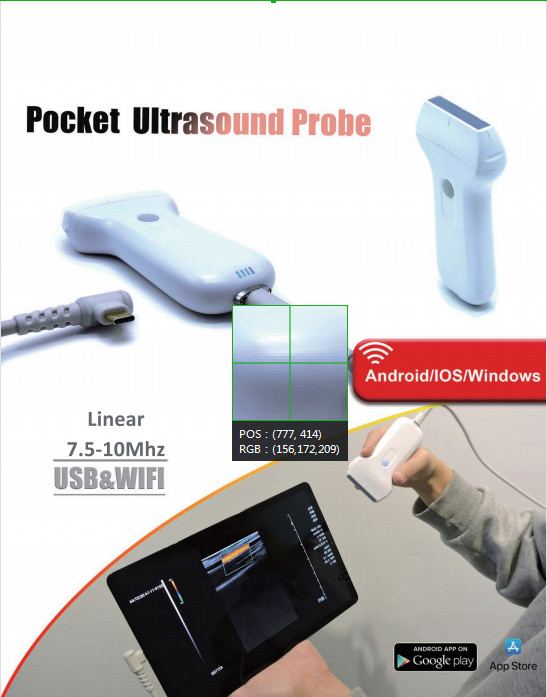 eBayNew
Wireless Ultrasound Probe Scanner WIFI Support iOS Android Windows
 eBayNew
Portable Wireless Ultrasound Probe Scanner Support iOS Android Windows
 eBayNew