Mindray DP-10 Review: A Budget Portable Ultrasound Worth Considering
Comprehensive Review of the Mindray DP-10: Unveiling Its Features and Performance
If you run a small clinic, a mobile practice, or a veterinary office, you already know the challenge: finding an ultrasound machine that delivers reliable imaging without draining your entire equipment budget. The Mindray DP-10 has positioned itself as one of the most popular entry-level B-mode ultrasound systems on the market, and for good reason. We put this machine through its paces to find out whether it truly lives up to the hype — or whether you should spend your money elsewhere.
Product Overview
The Mindray DP-10 is a compact, black-and-white digital ultrasound system designed by Shenzhen Mindray Bio-Medical Electronics, one of the largest medical device manufacturers in China. It targets general-purpose diagnostic imaging in clinics, point-of-care settings, emergency departments, and veterinary practices.
Key Specifications:
- Display: 12-inch high-resolution LED monitor
- Imaging Modes: B, B/B, B/M, M, 4B
- Transducer Ports: 2 active ports (no adapter needed to switch probes)
- Depth Range: Up to 300mm depending on probe
- Weight: Approximately 6.5 kg (14.3 lbs) for the main unit
- Cine Loop: Up to 256 frames
- Battery: Optional built-in lithium battery for portable use
- Storage: USB port for image/clip export, built-in hard drive
- Connectivity: DICOM 3.0 compatible
The DP-10 is designed for practitioners who need a workhorse diagnostic tool without the premium price tag of cart-based systems from GE or Siemens.
Hands-On Experience
Setup and First Impressions
Out of the box, the DP-10 feels surprisingly well-built for its price point. The chassis is a durable plastic-and-metal construction that doesn't creak or flex when you carry it. At 6.5 kg, it's genuinely portable — we carried it between exam rooms without fatigue, and the optional battery means you aren't tethered to a wall outlet during mobile visits.
Boot-up time clocks in at around 25 seconds, which is fast enough for urgent situations but not instant. The 12-inch LED screen is bright and clear with good viewing angles, though it doesn't compare to the 15-inch or larger displays found on premium systems.
Daily Use
The control panel layout is intuitive for anyone who has operated a diagnostic ultrasound before. The TGC sliders feel smooth, the trackball is responsive, and the most-used functions (freeze, gain, depth) are accessible with single button presses. We appreciated that Mindray placed the two probe ports on the side of the unit rather than the back — swapping transducers mid-exam takes seconds.
Image presets come pre-loaded for abdominal, OB/GYN, small parts, cardiac (limited), vascular, and veterinary applications. Selecting a preset automatically adjusts gain curves, dynamic range, and processing parameters. For a B-mode-only system, the preset optimization is noticeably well-tuned.
Standout Features
iClear Technology: Mindray's speckle reduction algorithm does a commendable job of cleaning up grainy images without over-smoothing tissue boundaries. In our experience, it makes the DP-10 punch above its weight class in image clarity — especially in abdominal scanning where speckle noise can obscure small structures.
iBeam Spatial Compounding: This feature combines multiple scan lines at different angles to produce a more uniform image with better tissue differentiation. It's particularly useful for superficial structures and musculoskeletal imaging.
Auto-optimization: A single button press adjusts gain and image parameters based on the current scan. It works well about 80% of the time, and when it doesn't, manual adjustments are straightforward.
Dual Probe Ports: Having two active ports eliminates the need to physically disconnect and reconnect probes. During a veterinary exam where we switched between a convex and linear probe, this saved meaningful time.
Pros and Cons
Pros
- Excellent image quality for a B-mode system at this price point
- Lightweight and genuinely portable at 6.5 kg
- Two active transducer ports for fast probe switching
- iClear speckle reduction significantly improves image clarity
- Intuitive control panel with minimal learning curve
- DICOM 3.0 support for integration with PACS systems
- Optional battery for truly mobile use
- Broad probe compatibility across Mindray's transducer line
Cons
- No color Doppler — strictly B-mode and M-mode imaging
- 12-inch screen feels small for extended scanning sessions
- No touchscreen interface (all physical controls)
- Limited cardiac capability without Doppler modes
- Image export via USB can be slow with large study files
- Print integration requires a separate compatible printer
- Software updates require a service visit in some regions
Performance Breakdown
Image Quality: 8/10 For a B-mode-only system, the DP-10 produces impressively clean images. The iClear processing and spatial compounding elevate it well above older B/W machines. Abdominal and OB imaging are its strongest applications. Small parts imaging is solid with the right linear probe.
Build Quality: 8/10 The unit feels robust and well-assembled. The control panel components — trackball, buttons, TGC sliders — all have a premium feel. The carrying handle is sturdy. We'd like to see a more protective screen cover for transport, but overall construction inspires confidence.
Value for Money: 9/10 This is where the DP-10 truly excels. At its price point (typically between $3,000–$6,000 depending on configuration and probes), it delivers diagnostic capability that would have required a $15,000+ system a decade ago. For budget-conscious practices, the value proposition is hard to beat.
Ease of Use: 8.5/10 Minimal learning curve. Experienced sonographers will be comfortable within minutes. New users benefit from the logical button layout and effective auto-optimization. The menu system is straightforward, though navigating deeper settings can require some manual reference.
Portability: 8.5/10 At 6.5 kg with optional battery power, the DP-10 is one of the more portable tabletop units available. It's not pocket-sized like a handheld probe, but it travels well between rooms and to field locations.
Who Should Buy the Mindray DP-10
- Small clinics and private practices that need reliable general-purpose imaging without a major capital investment
- Veterinary practices — the vet presets are well-optimized, and the portability suits large-animal field work
- Mobile and rural practitioners who need a battery-capable system they can carry to patients
- Training institutions looking for an affordable machine for students to learn B-mode scanning fundamentals
- Point-of-care settings where quick abdominal, OB, or guided-procedure imaging is needed
Who Should Skip the Mindray DP-10
- Practices that need color Doppler or spectral Doppler — the DP-10 simply doesn't have it. Look at the Mindray DP-50 or Z5 instead
- Dedicated cardiac imaging labs — without Doppler modes, cardiac assessment is extremely limited
- High-volume radiology departments — the 12-inch screen and B-mode-only limitation make it unsuitable as a primary departmental scanner
- Users who need advanced 3D/4D imaging — this is a 2D-only system
Alternatives Worth Considering
Mindray DP-50: If you need color Doppler but want to stay in the Mindray ecosystem, the DP-50 adds color flow and PW Doppler at a moderate price increase. It shares much of the DP-10's build quality and portability.
GE Logiq E Portable Series: The GE Logiq E Vet Next Gen portable ultrasound offers GE's imaging pedigree with more advanced features, but at a significantly higher price point. Worth it if your budget allows and you need Doppler capability.
Chison ECO Series: Chison's ECO-1 and ECO-2 compete directly with the DP-10 on price. Image quality is comparable, though we found Mindray's iClear processing gives the DP-10 a slight edge in most scanning scenarios.
If you're comparing against higher-end systems like the GE Logiq S8 ultrasound system, understand that the DP-10 is a fundamentally different class of machine — it's designed for affordability and portability, not to replace a full-featured cart system.
Where to Buy
The Mindray DP-10 is available through authorized Mindray distributors, medical equipment resellers, and online marketplaces. When purchasing, verify that the seller is an authorized dealer to ensure warranty coverage and access to service support.
Check current pricing and availability:
When buying used or refurbished, inspect the transducer connectors and screen for burn-in. Request a recent service report if available. Also check whether the unit includes probes — many listings sell the main unit only, with transducers priced separately.
You might also explore portable laptop ultrasound scanner options if extreme portability is your top priority.
Frequently Asked Questions
Is the Mindray DP-10 suitable for OB/GYN imaging?
Yes. The DP-10 performs well for basic obstetric measurements including BPD, FL, AC, and estimated fetal weight. It includes OB calculation packages with growth curves. However, without color Doppler, you won't be able to assess placental blood flow or perform umbilical artery Doppler studies.
Can I use the Mindray DP-10 for veterinary applications?
Absolutely. The DP-10 is widely used in veterinary practice for pregnancy detection, abdominal scanning, and tendon/ligament assessment in large and small animals. Mindray offers veterinary-specific transducers that pair well with this unit.
Does the Mindray DP-10 have color Doppler?
No. The DP-10 is a B-mode and M-mode only system. If you need color or spectral Doppler, consider upgrading to the Mindray DP-50 or Z5 series.
How long does the battery last on the Mindray DP-10?
The optional built-in lithium battery typically provides approximately 1.5 to 2 hours of continuous scanning, depending on screen brightness and probe usage. This is sufficient for most mobile visits but may require planning for extended field sessions.
What probes are compatible with the Mindray DP-10?
The DP-10 supports a range of Mindray transducers including convex (35C50EA, 65C15EA), linear (75L38EA, 75L53EA), micro-convex (65EC10EA), and transvaginal (65EV13EA) probes. Always verify compatibility with your specific DP-10 software version.
How does the Mindray DP-10 compare to handheld ultrasound devices like the Butterfly iQ?
They serve different purposes. Handheld devices like the Butterfly iQ offer extreme portability and smartphone connectivity but typically have smaller screens and less processing power. The DP-10 provides significantly better image quality, a larger display, physical controls for precise adjustments, and dual probe ports — making it better suited for dedicated diagnostic work rather than quick point-of-care scans.
Final Verdict
The Mindray DP-10 is one of the best values in diagnostic ultrasound today. It delivers clean B-mode imaging with smart processing features like iClear and iBeam, wraps it in a genuinely portable package, and does it all at a price that makes ultrasound accessible to practices that couldn't previously justify the investment. If you don't need Doppler and your primary applications are general abdominal, OB, MSK, or veterinary imaging, the DP-10 deserves serious consideration. It won't replace a full-featured cart system, but for what it's designed to do, it does it remarkably well. ```

2020 Mindray M7 Portable Ultrasound with C5-2S and L12-4S Transducer Probes
View Deal →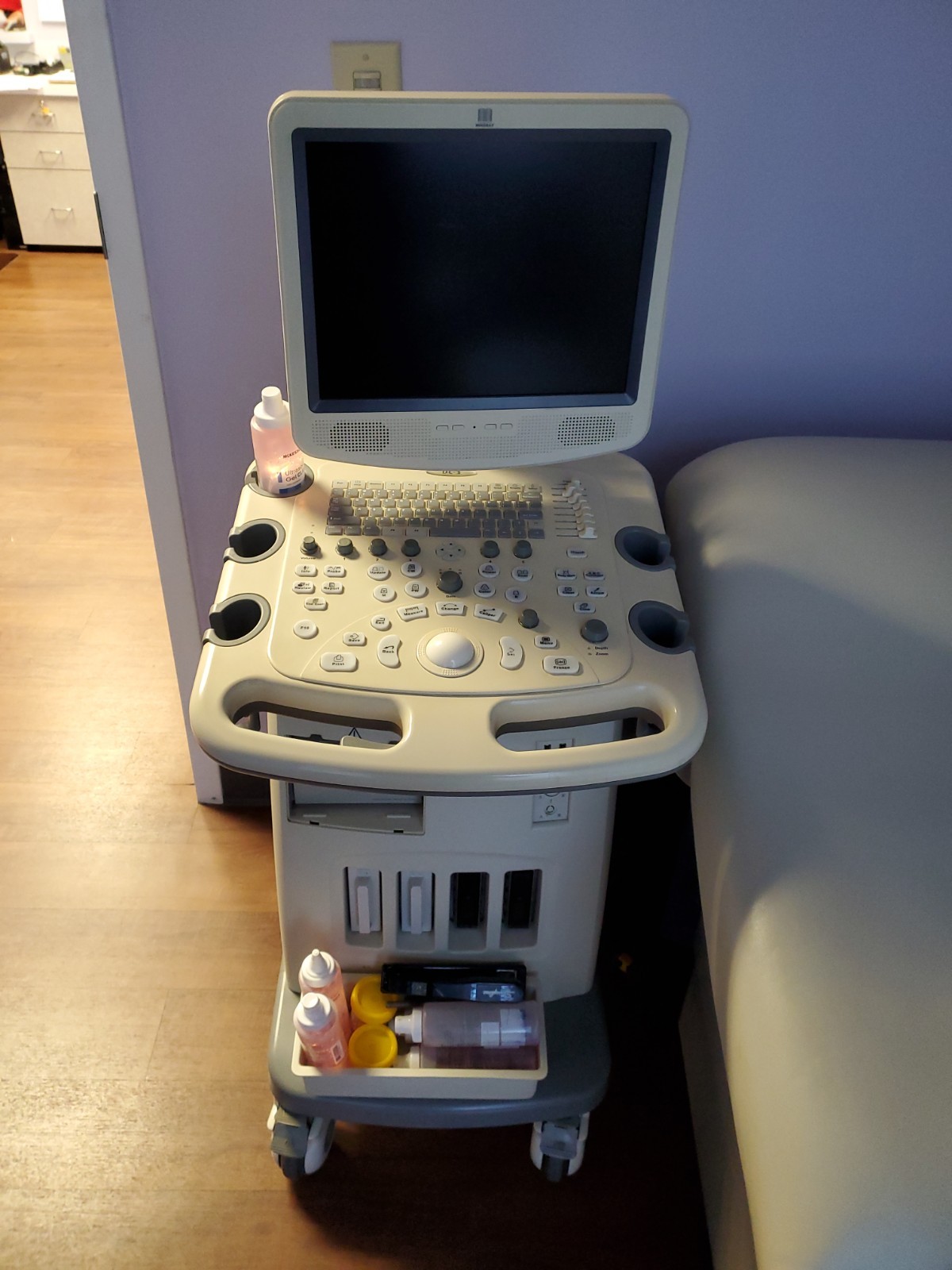
Mindray DC3 Ultrasound Machine Fully Equipped Convex Abd Probe And TV Probe
View Deal →
Mindray DP50 Ultrasound with Probe choice. 3-year warranty.
View Deal →
Mindray 65EC10EB Vaginal Probe For DP-10, DP-7700, DP-3300,Compatible Transducer
View Deal →
Mindray 75L50EAV Linear Ultrasound Transducer for DP-10 vet/Z5 Vet,Generic probe
View Deal →